


The adonis belt is a ligament, not a muscle-no exercise directly builds it. Instead, targeted exercises develop the surrounding obliques, lower abs, and hip flexors that frame it visually. The adonis belt emerges through fat loss combined with strategic muscle development in the adjacent regions.
For the complete picture of adonis belt anatomy, fat loss requirements, and the full training and nutrition protocol, this adonis belt exercises and training guide covers the science in depth.
The Most Important Thing to Understand About Adonis Belt Training
The adonis belt is not a muscle. It’s the groove created by the inguinal ligament running from the hip bone to the pubic area. You cannot train a ligament into visibility. The adonis belt becomes visible through fat loss – specifically, reducing the subcutaneous fat layer over the lower abdomen until the ligament groove shows through.
This distinction matters because it reframes the entire approach to adonis belt development. Most training protocols waste time on direct lower ab isolation under the assumption that building the rectus abdominis will somehow make the adonis belt pop. It won’t. A thicker rectus abdominis sits above the inguinal ligament, not along it. The adonis belt is defined by what’s beneath the fat, not by muscle size in that region.
What training can do is develop the surrounding muscles – the obliques, hip flexors, lower abs, and transverse abdominis – so that when body fat is low enough, the adonis belt is framed by developed musculature that makes it visually striking. The muscularity creates contrast. The ligament groove itself creates definition. Together, they form the aesthetic.
Exercises That Support Adonis Belt Development
1. Hanging Leg Raises with Rotation
Hanging from a pull-up bar and raising the legs while rotating at the top of the movement develops both the lower rectus abdominis and the obliques simultaneously. This builds the muscular frame immediately above and to the sides of the adonis belt. The rotation component is critical – it recruits the external obliques, which create the visual transition from the rib cage down to the hip.
Execution matters. The rotation should occur at peak leg height, not during the ascent. Use a controlled 2-second ascent, a 1-second hold with rotation, and a 3-second descent. Progress from knee raises to straight-leg raises as strength develops. Once straight-leg raises become easy, add 5-10 pounds of ankle weight to continue driving adaptation.
2. Cable Woodchops
Diagonal cable movements from high to low (and low to high) develop the obliques through a full range of motion under constant tension. The rotational component is important – obliques are built through rotation, not just lateral flexion. Use a moderate weight that allows full range of motion and controlled deceleration.
High-to-low woodchops (from shoulder height down across the body) are particularly effective for the lower obliques and the region directly adjacent to the adonis belt. Perform these for 8-12 reps per side, emphasizing the contraction at the bottom of the movement. The cable provides tension throughout the movement, which is why woodchops outperform free-weight rotational movements for oblique development.
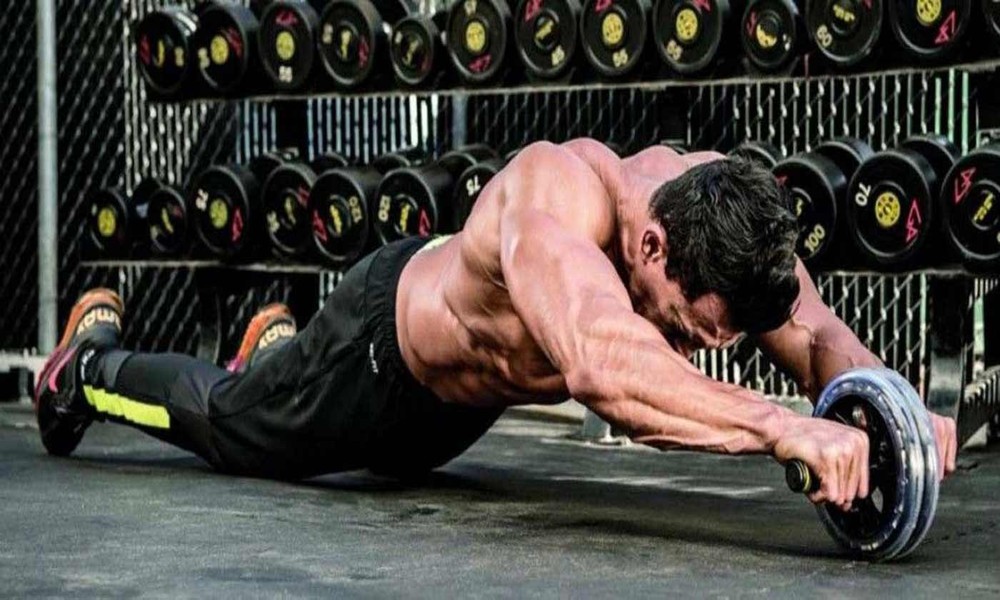
3. Ab Wheel Rollouts
The ab wheel is one of the most effective exercises for the transverse abdominis – the deep stabilising layer of the abdominal wall. A tight, developed transverse abdominis pulls the midsection flat and creates the taut surface against which the adonis belt lines stand out clearly. This is mechanistically important: the transverse abdominis acts like an internal corset. Greater tone in this muscle improves anterior core stiffness, which makes all abdominal musculature appear more defined.
Progress from kneeling to standing rollouts as strength improves. Beginners should aim for 3 sets of 6-8 reps from the knees, focusing on controlled eccentric lowering. The descent should take 3-4 seconds; this time under tension drives adaptation in the transverse abdominis more effectively than faster, shorter-range reps.
4. Suitcase Carries
Carrying a heavy weight on one side while walking develops the lateral stabilisers of the core – the quadratus lumborum and lateral obliques – that contribute to the aesthetic line from waist to hip. These muscles directly flank the adonis belt region and their development enhances its visual impact.
The key is unilateral loading. A dumbbell or kettlebell in one hand forces the ipsilateral oblique and quadratus lumborum to contract hard to prevent spinal flexion toward the weighted side. Perform carries for distance: aim for 40-60 meters per side, using a weight heavy enough that you feel significant core tension but light enough that posture doesn’t degrade. Suitcase carries also build grip strength and thoracic stability as secondary benefits.
5. Dragon Flags
Dragon flags are an advanced movement that develops the entire anterior core under high tension. They build the lower rectus abdominis and hip flexors simultaneously – both of which sit adjacent to the adonis belt and contribute to the overall V-shape aesthetic of the lower torso. The movement is technically demanding, making it effective for advanced trainees who have already built a foundation with hanging leg raises.
Progression is essential: begin on a decline bench with the knees bent and only partial range of motion, then advance to fuller range of motion with straight legs. The transverse abdominis must be actively braced throughout to prevent spinal hyperextension. This is why dragon flags are superior to supine leg raises – they demand greater neural activation and build greater overall core tension.
6. Compound Lifts for Overall Leanness
Squats, deadlifts, pull-ups, and presses are arguably the most important exercises for adonis belt visibility – because they produce the greatest metabolic demand and catecholamine response, driving overall fat loss. The adonis belt is revealed through fat loss. Compound lifts are the primary tool for driving fat loss. This relationship is often overlooked in favour of direct ab training.
A heavy squat or deadlift session increases energy expenditure for hours post-training and creates an acute hormonal shift that favors fat mobilization. Over weeks and months, consistent compound training combined with appropriate nutrition creates the cumulative deficit required to drop body fat from 20% to the 12-15% range where the adonis belt begins to emerge. Direct ab work alone cannot drive this level of fat loss.
Exercises That Won’t Help
Side Bends
Side bends primarily work the quadratus lumborum and, when loaded, can actually increase the apparent width of the waist – the opposite of what you want when trying to create a sharp V-shape in the lower torso. Avoid loaded side bends if adonis belt aesthetics are the goal.
The mechanism is straightforward: loaded side bends under fatigue often result in forward trunk lean, which recruits the rectus abdominis and increases intra-abdominal pressure. Over time, this can create bloating or distension in the lower abdomen. Unloaded side bends (using body weight only) have minimal training stimulus and are simply inefficient compared to cable woodchops for oblique development.
Spot-Reduction Cardio
No exercise burns fat from a specific location. The lower abdominal fat covering the adonis belt is governed by receptor biology – specifically alpha-2 receptor density – not by proximity to a working muscle. Hours of lower ab exercises will not accelerate fat loss from the adonis belt region.
The lower abdomen is often the last place fat is lost because of higher concentration of alpha-2 receptors (which inhibit fat mobilization) and lower concentration of beta-2 receptors (which promote it). This is partly genetic and partly hormonal. Training that spot should be abandoned entirely. Instead, focus on total-body fat loss driven by compound strength training and appropriate nutrition.
High-Rep Machine Ab Work
Machine-based ab exercises at high reps build minimal muscle mass and create negligible metabolic demand. The time is better invested in compound movements that drive total body fat loss. A 50-rep set on an ab machine might feel like work, but it creates no meaningful hypertrophic stimulus and no meaningful energy expenditure. It is pure time-wasting.
The Training Programme Structure That Works
An effective programme for adonis belt development balances three elements:
- Compound strength training (3-4 sessions per week) – the primary driver of fat loss and overall muscle development
- Direct core work (2-3 sessions per week) – hanging leg raises, cable woodchops, ab wheel, planks – to develop the muscles surrounding the adonis belt
- Fat loss nutrition – addressing the hormonal environment governing lower abdominal fat storage, not just creating a generic caloric deficit
Core work should be integrated into training days rather than performed as standalone sessions. Add 2-3 core exercises to the end of compound training sessions, each for 3 sets of 6-12 reps depending on the exercise. This approach conserves recovery capacity while ensuring adequate stimulus for oblique and lower abdominal development.
How Long Until the Adonis Belt Is Visible?
With consistent training and appropriate nutrition, most men begin to see adonis belt emergence at 12-15% body fat. Getting there from a starting point of 20% body fat typically takes 16-30 weeks depending on the approach taken and individual response.
The final stage – getting from 15% to 12% where the adonis belt becomes clearly defined – is often the hardest and slowest, precisely because the lower abdominal fat in this range is the most receptor-resistant. Understanding and addressing the hormonal environment at this stage is the difference between breaking through to adonis belt visibility and stalling just short of it. At this point, nutrition precision, sleep, and stress management become as important as training itself.
Frequently Asked Questions
Can you build an adonis belt without losing fat?
No. The adonis belt is a ligament groove that only becomes visible once subcutaneous fat is low enough. You cannot train a ligament into prominence. Building muscle in the surrounding regions (obliques, lower abs, hip flexors) enhances the aesthetic once the ligament shows, but fat loss is the primary requirement.
Which exercise builds the adonis belt fastest?
No single exercise builds the adonis belt itself, but compound strength lifts (squats, deadlifts, pull-ups) drive the fat loss necessary to reveal it most efficiently. Direct core work like hanging leg raises and cable woodchops develops the framing musculature that makes it visually striking once visible.
What body fat percentage do you need to see an adonis belt?
Most men begin to see adonis belt emergence at 12-15% body fat. Visibility and definition improve progressively as body fat drops further. The exact threshold varies by genetics, with some individuals showing definition earlier and others requiring lower body fat due to individual fat distribution patterns.
Do side bends help build the adonis belt?
No. Side bends can increase apparent waist width and are inefficient for oblique development compared to rotational exercises like cable woodchops. They should be avoided if adonis belt aesthetics are the goal. Rotational and anti-rotational core exercises are far more effective for the muscularity you need.